Manuel’s res earch interests include comparative democratization, religion and politics, and comparative public policy, with a focus on Portugal. He is currently working on six projects.
First, he is working with Dr. Daniela Melo of Boston University on two projects. One of them examines social movements in Portugal. They have assembled a group of leading scholars for this new volume to be published in the Portuguese-Speaking World Series by Liverpool University Press.
Second, with Daniela Melo, he is also working on the “Portuguese in Massachusetts Civic Life project.” They have designed a survey to get a sense of how Portuguese and Portuguese Americans engage their communities in Massachusetts. The results of the survey will help with their research. They seek to better understand how the Portuguese have managed to build their own distinctive community in Massachusetts. Building on both the state political culture and social capital literature, this project asks how the immigrant Portuguese community has adapted to life in Massachusetts. More specifically, it wonders which strategies both Portuguese-American community leaders and elected officials have used in order to help their ethnic group assimilate into the larger fabric of Massachusetts society, all the while maintaining their cultural and religious distinctiveness; and, what this case may teach us about how new immigrant groups engage the larger American society.
Third, Glatzer and Manuel are co-editing a special volume of the journal Religions, focusing on Catholic Social Teaching and Social Welfare.
Fourth, Manuel is working on a book project called The ‘Catholic Question’ in Contemporary Portugal: Of Democracy, Devotion and Secularization. It explores the ‘Catholic question’ in contemporary Portugal: whether Catholicism will remain a force in Portuguese associational life in the next century, or whether it faces a future of slow and steady decline. This research project seeks to move beyond the lens normally applied to the question of Catholicism in contemporary Europe (i.e. it is a dying, anti-modern, anti-rational, conservative institution), and instead consider the complex interplay of its demographic challenges combined with the popular sources of its theological and spiritual strength, as well as its vital societal contributions, to assess whether or not it will remain a force in Portuguese associational life in the future.
Scholarly Activities
 Over the past several years, Paul Manuel has also served as a county expert (Portuguese-speaking world) on the Varieties of Democracy project, which is based at the University of Gothenburg, Sweden, According to the V-Dem project: “Varieties of Democracy(V-Dem) is a large international effort to measure hundreds of features of democracy for all countries and colonies in the world from 1900 to the present. V-Dem is also capturing democracy in a much broader sense than any existing indices do: not only electoral and liberal aspects but participatory, egalitarian, consensual, majoritarian, and deliberative dimensions. Thus, rather than using a single standard for democracy, we measure multiple versions of democracy that are widely understood around the globe.”
Minda de Gunzburg Center for European Studies at Harvard University (CES)
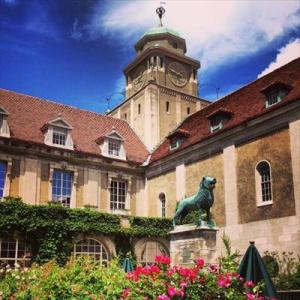 Manuel is an affiliate at CES, which has given me access to their numerous scholarly resources.
Highlights: Over the last twenty-five years, Manuel has served as a CES Visiting Scholar, a co-chair of the Iberian Study Group, and helped to organize three major conferences at CES on Portugal and Spain-resulting in the publication of two volumes. He has also authored or co-authored several CES working papers. Other publications resulting from research done at CES include “Portuguese Exceptionalism and the Return to Europe: The 25 April 1974 coup and democratization,” in Laura C. Ferreira-Pereira, Portugal in the European Union: Assessing Twenty-Five Years of Integration Experience (Routledge Advances in European Politics, 2014: 15-30); “The 1998 and 2007 Referenda on Abortion in Portugal: Roman Catholicism, Secularization and the Recovery of Traditional Communal Values,” South European Society and Politics (13,1, Summer, 117-128); “Some Lessons from the Fifteenth Anniversary of the Accession of Portugal and Spain to the European Union,” South European Society and Politics, (8, 1, Spring 2004 , 1-31), with Sebastian Royo; “Revisiting Portuguese Civil Society,” South European Society and Politics 4, 2, Summer 1999, 71-99; and “The Process of Democratization in Portugal,” Portuguese Studies Review, 7, 1 Spring 1998, 33-47.
Current Activities: Paul Manuel has participated in the intellectual life of the Center with the recent publication of a peer-reviewed article in Harvard’s Open Forum series entitled “Corporal Works of Mercy in a time of Austerity: The Role of Roman Catholicism in Contemporary Portugal.” He has also served as a manuscript reviewer for the Open Forum series.
Berkley Center for Religion, Peace and World Affairs at Georgetown University
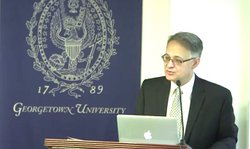
Paul Manuel also currently holds a Research Fellow appointment at the Berkley Center for Religion, Peace and World Affairs at Georgetown University. He organized a research symposium on religion and politics in the Portuguese-speaking world at the center in October 2015 and one on Pope Francis in 2018.
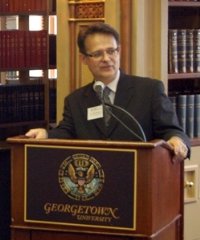
Highlights: Manuel hosted a panel on volume, Religion and Politics in a Global Society: Comparative Perspectives from the Portuguese-Speaking World with Lexington Books. It examines faith-culture relations in the Portuguese speaking world, featuring case-studies on Portugal, Brazil, Angola, Mozambique, Goa and East Timor. That volume followed from his 2006 edited volume, The Catholic Church and the Nation-State: Comparative Perspectives, published by Georgetown University Press.
He moderated a panel discussion with Father Tom Massaro, S.J., of Fordham University, about the papacy of Pope Francis in 2018.
 Research Grants
Paul Manuel has been successful in securing outside research grants throughout his career, including support from the Fulbright Foundation, the Tinker Foundation, the Gulbenkian Foundation (Lisbon) and the Center for the Humanities at the University of New Hampshire. He also participated in a National Endowment for the Humanities Seminar for College Professors on Comparative Democratization at Cornell University. Manuel also served on the National Screening Board of the Graduate Fulbright Program in Spain and Portugal for M.A. and Ph.D. candidates from 2004 to 2007.
Professional Affiliations
Paul Manuel belongs to these professional organizations:
• American Political Science Association
• New England Political Science Association
• International Studies Association
• Global International Studies Association

 Professional Portfolio of Paul Christopher Manuel