The family’s roots lie in Xartinho and Mata do Rei, in the parish of Alcanede, and its American story begins with his grandparents’ marriage in New Bedford, Massachusetts, on July 8, 1922.
- 2025 He restores his great-grandmother’s grave at Alcanede
- 1949–1969 On donkeys in Xartinho and Mata do Rei
- January 26, 1946 Death of his great-grandmother, Maria Gertrudes Manuel
- November 22, 1937 Maria Rosa Manuel becomes an American citizen
- August 15, 1936 Joaquim Manuel released from Portuguese military service
- c. 1935 His great-grandparents with their son Silvino, Santarém
- April 27, 1931 Joaquim Manuel becomes an American citizen
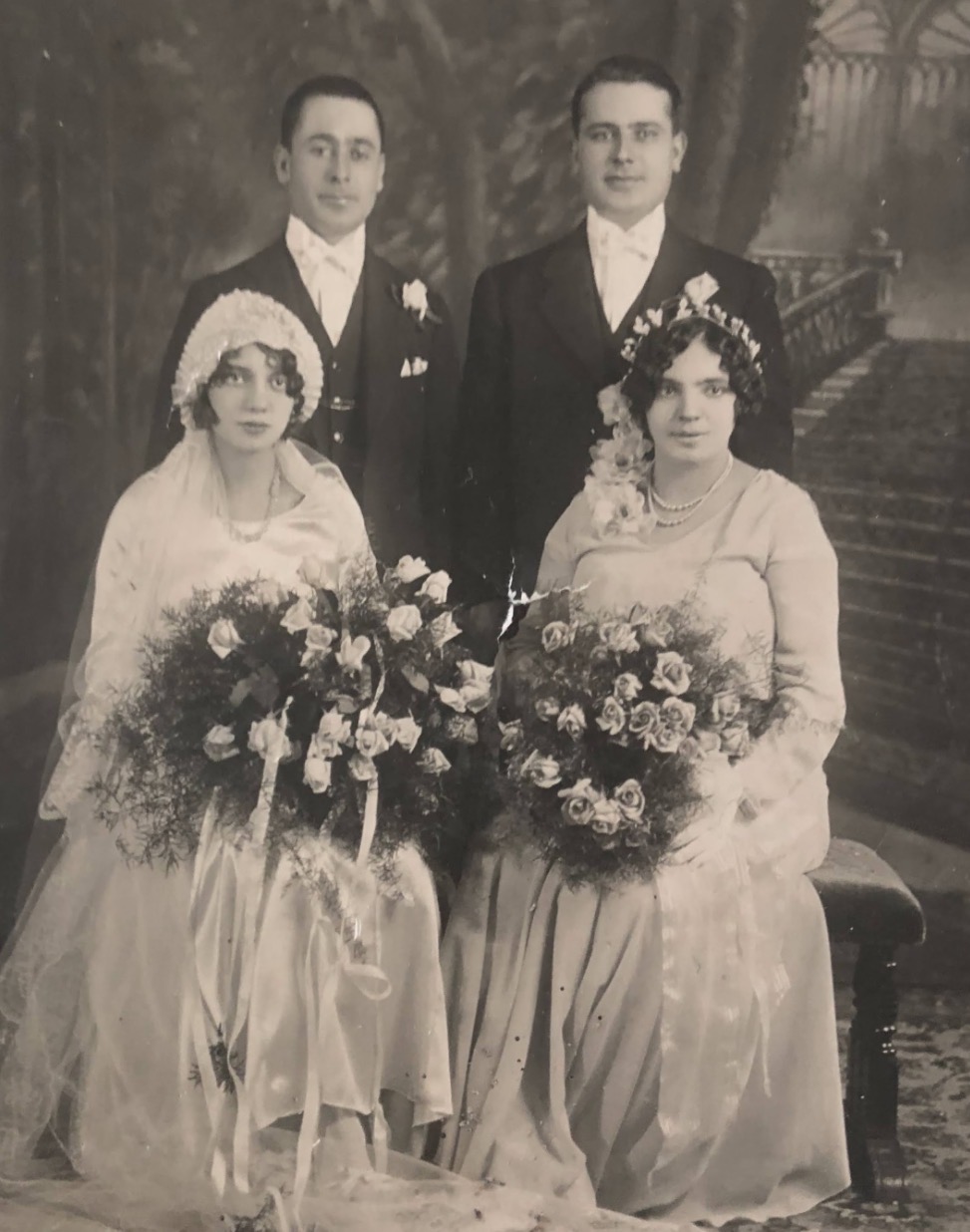
- July 8, 1922 Joaquim Manuel and Maria Rosa dos Santos marry in New Bedford, Massachusetts
The Family’s Roots
Xartinho, Mata do Rei and Alcanede
Maria Gertrudes Manuel
His great-grandparents, José Manuel Júnior and Maria Gertrudes Manuel, lived in Xartinho. Maria Gertrudes died on January 26, 1946, and is buried in the cemetery at Alcanede. From America, his grandfather, Joaquim Manuel, Sr., sent money so that his mother would be properly buried, and he later returned to visit her grave faithfully every year.
Her Grave at Alcanede
Dr. Manuel first visited her grave with his grandparents in the summer of 1978, and in 2025, as her great-grandson, he restored it. The photographs of the family at her grave, from 1961 to 2025, are gathered on The Family Campo Santo at Alcanede page.

Becoming Americans
New Bedford and Providence, 1922–1937
Married in New Bedford, 1922
Joaquim Manuel and Maria Rosa dos Santos were married in New Bedford, Massachusetts, on July 8, 1922, by Rodolphus A. Swan, the city clerk and a justice of the peace. The record gives the groom’s age as twenty-one and his work as mill man, and the bride’s as eighteen and mill operative, and it names their parents: José and Maria Gertrudes, and Joaquim B. and Rosa Maria Santos.
American Citizens, 1931 and 1937
Joaquim Manuel became an American citizen in the United States District Court at Providence, Rhode Island, on April 27, 1931, three months after the birth of his son, Joaquim, Jr.; the family was then living at 437 Woodbine Street in Cranston. Maria Rosa Manuel followed on November 22, 1937. Each certificate carries the holder’s photograph.
Released from Portuguese Military Service, 1936
On August 15, 1936, the Consulate of Portugal in Providence issued Joaquim Manuel a provisional exemption from all Portuguese military service under Decree-Law 24.922 of January 10, 1935, after he paid a fee of $80 toward the army. The document names his parents as José Manuel Júnior and Maria Gertrudes.


On Donkeys
Xartinho and Mata do Rei, 1949–1969
Torga’s Morgado
In Miguel Torga’s Bichos (Coimbra, 1940), a collection of fourteen stories about animals, one story, “Morgado,” is about a donkey. Morgado is servile and kind, and critics have read him against the cruelty of his master, who abandons him on a mountain road at night, where the wolves take him. Torga set much of his work in the rural north, and many Portuguese readers come back to Bichos for the village life it remembers: the hard work of the land in the 1930s, and the animals that shared that work with families. For them the book is a route to saudade.
The Donkey and the Immigrant
For Portuguese immigrants in America, the donkey carried a similar nostalgia. It stood for a simpler way of life in the old country, with fewer demands and fewer complications than the mills and cities of New England. Maybe that picture was romanticized, since village life had been hard, but it gave people a sense of peace, connection and belonging, and that is why, on their visits home, they went back to the donkey.
The Family on Donkeys, 1949 and 1969
Dr. Manuel’s father, Joaquim (Jack) Manuel, Jr., sat on one in the village in 1949, at eighteen, with an accordion in his hands. Twenty years later his mother, Maria Rosa, was photographed on a donkey with his father, Joaquim Manuel, Sr., and cousins in Xartinho and Mata do Rei.
