English Language · Idioma · Langue · Lingua · Язык
语言 · भाषा · اللغة · زبان
Since 1997 Dr. Manuel has helped found and direct academic institutions and programs, among them the New Hampshire Institute of Politics, the Institute for Leadership at Mount St. Mary’s University, the Leadership Program at American University’s School of Public Affairs and Georgetown’s Foreign Policy Academy.
Academic Administration and Building Institutions
Leading departments, programs and organizations, and founding new ones
Dr. Manuel directs the Foreign Policy Academy, Georgetown’s three-week residential summer program in U.S. foreign policy. He is responsible for its curriculum, its faculty mentors and guest speakers, its embassy and Department of State visits, and its assessment. The 2026 cohort had 94 students from 35 states and 20 countries. The appointment is ongoing, and he returns as academic director for Summer 2027.
Dr. Manuel directed the practicum for the Master of Arts in American Government. He was responsible for advising students, finding and overseeing their site placements, and assessing their work.
Dr. Manuel served two elected terms on the association’s Executive Council, 2006–2008 and 2019–2024, and was program co-chair of its 2008 annual meeting.
Directed the 15-credit Leadership Program in the School of Public Affairs for seven years.
From October 2015 to December 2022 Dr. Manuel directed the Leadership Program in American University’s School of Public Affairs, a 15-credit sequence of courses, internships and two civic leadership projects that leads to a Certificate in Advanced Leadership Studies. He was responsible for its curriculum, assessment, staffing, budget and recruitment, advised some 170 students a year and supervised five staff. He designed the courses “Power, Politics, and Persuasion in D.C.” and “Leadership Development Lab” and added hybrid and online learning, an e-portfolio program and student retreats.
Dr. Manuel set up the Mount’s fellowships office, assembling an interdisciplinary faculty committee to advise students applying for national awards such as the Fulbright. Mount students then won Fulbright English Teaching Assistant awards for the first time in the university’s history, and the university has produced Fulbright winners every year since.
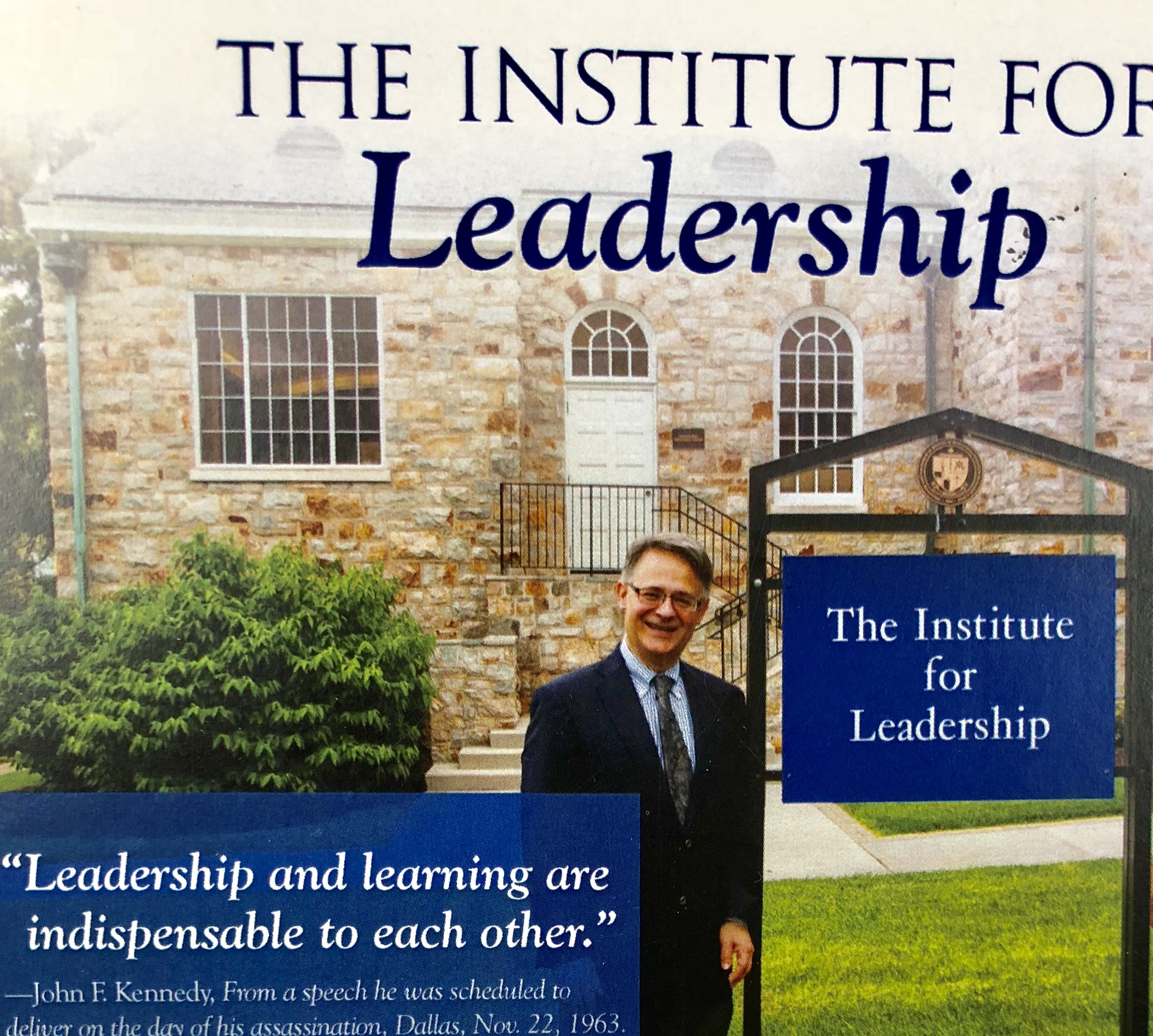
Built the leadership curriculum for the university’s new common educational experience and directed its Institute for Leadership.
The president of Mount St. Mary’s University asked Dr. Manuel in 2010 to build a leadership curriculum into the university’s new common educational experience. Working with deans, faculty, staff and students in all four schools and with the Mount Career Center, he wrote the founding white paper for a curriculum organized around engaged citizenship and professional preparation; the faculty approved it by a vote of 48 to 23, or 68 percent of the votes cast, and the Board of Trustees adopted it, and it formed part of the university’s 2015 Middle States reaccreditation report.
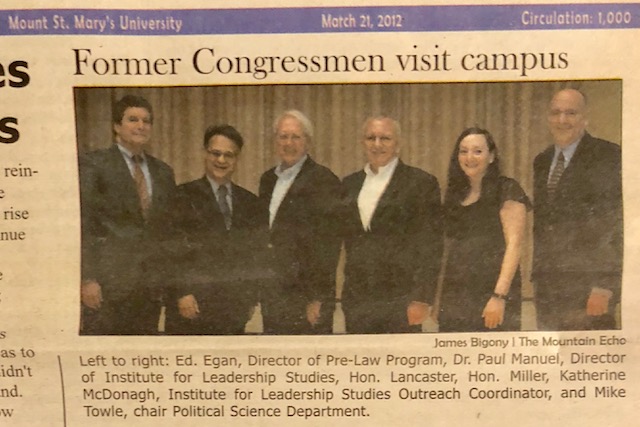
As founding director he reported to both the provost and the executive vice president for student life, supervised five staff, advised some 500 students a year, secured more than $100,000 in grants and launched an emerging leader certificate program. With a grant from the Apgar Foundation, he worked with the faculty of the College of Liberal Arts on bringing the theme of leadership into the liberal arts curriculum. He formed an off-campus Advisory Council that connected students with leaders outside the university, served on the Veritas Freshman Symposium Steering Committee, and supervised the Congress to Campus program, the European Union Simulation and the Maryland Student Legislature. In 2014 he was granted tenure in the political science department.
Managed staff, budget, grants and educational programs at a Washington-area think tank.
At the Institute for Global Engagement, a Washington-area think tank, Dr. Manuel managed 17 staff and a multimillion-dollar budget, oversaw more than $1 million in grants, and ran its educational programs, policy forums and university partnerships. He organized two global leadership conferences on Muslim-Christian understanding at Georgetown University, in 2009 and 2010.
Chaired the department for fifteen years as it grew from two faculty and 35 majors to seven faculty and 150 majors.
During Dr. Manuel’s fifteen years as chair the department grew from two faculty and 35 majors to seven faculty and 150 majors, adding tenure-track lines, an international relations major and a public policy certificate. He worked on the college’s New England accreditation self-studies of 1998 and 2008, and as a faculty senator (1999–2001) he worked on shared governance, faculty hiring, promotion and tenure, and academic freedom. He became full professor in 2002.
He established the Upsilon Lambda chapter of Pi Sigma Alpha, the national political science honor society, at Saint Anselm College in 1995.

Set up the Institute’s four research centers and ran it through the 2008 New Hampshire presidential primary.
As research director Dr. Manuel set up four research centers, among them a Survey Research Center for public opinion polling, and connected sixteen academic departments to the Institute’s work through interdisciplinary teaching, faculty and student research support, and film, speaker and working paper series. As executive director he ran the Institute through the 2008 New Hampshire presidential primary, a period in which he appeared frequently on national and international television and radio.
Chaired the campus committee that developed the Institute and wrote the proposal the trustees approved in June 1998.
The idea came from a politics student, Zach McLaughlin ’98, a work-study student for both Dr. Manuel, then chair of the Department of Politics, and Anne Botteri of the college’s development office, who suggested an institute modeled on the Institute of Politics at Harvard’s Kennedy School. Dr. Manuel, Botteri and politics professor Dale Kuehne took up the idea. The college’s president then asked Dr. Manuel to chair a campus-wide committee to develop it; he wrote the final proposal and presented it to the Board of Trustees, which approved it in June 1998.
Dr. Manuel remained department chair while taking on the college-wide work of building the Institute, reporting to the executive vice president for academic affairs and working with the architects on the design of its academic and public spaces. He worked with the Office of the President and Senator Judd Gregg’s office to secure $14 million in federal funds for the Institute, and helped to form its Public Advisory Council.


The white papers, histories and articles below record how the New Hampshire Institute of Politics and the Institute for Leadership at Mount St. Mary’s University were conceived and built, from the 2000 white paper on the NHIOP to the history written for its twenty-fifth anniversary in 2026.
The First Fifteen Years of the New Hampshire Institute of Politics in Photographs: Concept, Construction and Programs
These photographs follow the New Hampshire Institute of Politics through its first fifteen years, from the 1999 announcement and the first $2 million grant to the construction of its building and the programs that filled it.